
Mantis Shrimp Have 16 Types of Color Receptors in Their Eyes
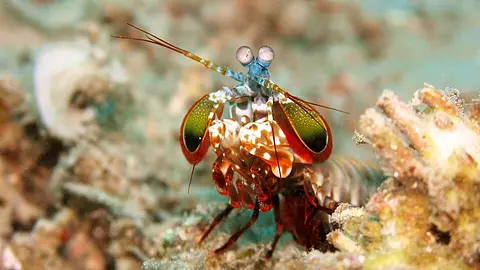
Mantis shrimp possess the most complex vision system of any animal on Earth, with up to 16 different types of photoreceptor cells in their eyes. In contrast, humans have only 3 types, and even most other animals have fewer than 5. This extraordinary visual capability allows mantis shrimp to see ultraviolet, visible, and polarized light simultaneously.
More detail
Stomatopod crustaceans, commonly known as mantis shrimp, have evolved eyes with remarkable optical complexity. These creatures live on shallow coral reefs where their vision is critical for hunting prey, evading predators, and communicating with potential mates. The 16 distinct photoreceptor classes in their compound eyes are arranged in specialized geometric patterns that allow for filtering and tuning light reception. Some photoreceptors use optical filters—pigments packed into vesicles—to enhance spectral sensitivity in narrow wavelength ranges. Additionally, mantis shrimp have cerebral photoreceptors (light-detecting cells in their brain) that remain functional even in blinded individuals, suggesting backup sensory mechanisms. Their visual range extends from approximately 300 nanometers in the ultraviolet to over 700 nanometers in the visible spectrum. This comprehensive color vision capability is thought to have evolved to maximize information gathering in the complex, colorful reef environment and to enable sophisticated visual communication between individuals.





Comments 0
No comments yet. Be the first!
Sign in to leave a comment.